---
title: About Us - Discover who we are and what we do
description: Aplos NCA offers secure, cloud-based non-compartmental (NCA) pharmacokinetic (PK) analysis and reporting tool. Discover who we are.
---
[](https://aplosanalytics.com?hsLang=en)
- ABOUT US
### [New Aplos NCA More Ways to Work with Aplos NCA](https://aplosanalytics.com/the-new-aplos-nca)
### [About Us Who we are and what we do](https://aplosanalytics.com/about-us?hsLang=en)
### [Security & Compliance Explore Aplos NCA security and compliance](https://aplosanalytics.com/security-compliance-for-regulated-pk-workflows-aplos-analytics?hsLang=en)
- [PRICING](https://aplosanalytics.com/plans?hsLang=en)
- RESOURCES
### [Blog Article and News](https://aplosanalytics.com/blog?hsLang=en)
### [Videos How-to videos, interviews, and other resources](https://aplosanalytics.com/aplos-analytics-resources?hsLang=en)
### [Documentation Everything you need to know about Aplos NCA](https://docs.aplosanalytics.com/)
### [Publications and Tech Sheets Read our quick overviews and publications](https://aplosanalytics.com/resources-publications-and-one-pagers?hsLang=en)
### [Press Releases Check our latest News and Press Releases](https://aplosanalytics.com/press-releases?hsLang=en)
### [Events Find us at the next big event](https://aplosanalytics.com/events?hsLang=en)
### [Use Cases Explore our customer success stories](https://aplosanalytics.com/use-cases?hsLang=en)
### [AplosNCA R Package **AplosNCA**, the official R package supporting version 3 of the Aplos NCA API.](https://aplosanalytics.com/rpackage?hsLang=en)
- [SUPPORT](https://aplosanalytics.com/support?hsLang=en)
- [CONTACT US](https://aplosanalytics.com/contact-us?hsLang=en)
[LOG IN](https://app.aplos-nca.com/) [GET A DEMO](https://aplosanalytics.com/demo-free?hsLang=en)
# You Spoke, We Built: The Redesigned Aplos NCA
### Built from customer feedback. Designed for the way scientists work.
NEW UPDATE
## Built from customer feedback. Designed for the way scientists work.
Over the past three and a half years, Aplos NCA has evolved from a fast PK parameter calculation engine into a comprehensive cloud-based platform supporting workflows from dataset formatting through report generation.
Our recent update is a direct result of customer feedback, introducing new capabilities that simplify PK analysis while maintaining the lightning-fast calculations and regulatory compliance users already trust.
[LET'S CHAT](https://aplosanalytics.com/demo-free?hsLang=en)
## We Built This For You
The most requested capability was a simpler way to create figures and tables.
Aplos NCA already supported custom outputs, but users had to prepare instructions in JSON-formatted text. Scientists did not want to spend time learning a new structured text format just to produce the plots and tables they needed.
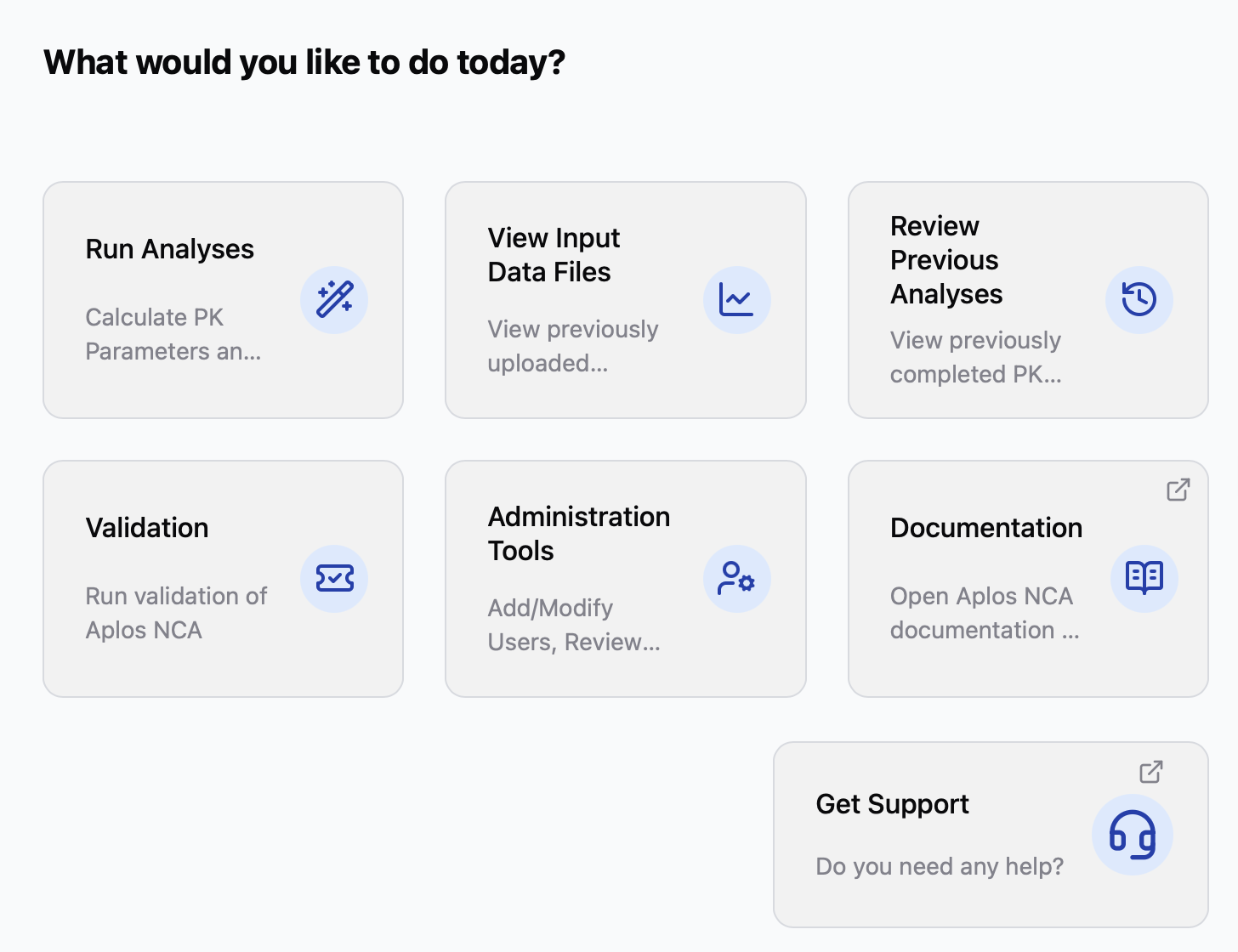
The new point-and-click interface removes that barrier. Users can now configure outputs directly through the platform, while Aplos NCA automatically creates the underlying JSON-formatted instructions in the background.
This means analyses can be reused and adapted later, helping users accelerate future work without rebuilding configurations from the beginning.
The second major request was a clearer view of how analysis components depend on one another. Users wanted to see the full relationship between the initial uploaded dataset, the PK analysis, the resulting plots and tables, and the final report outputs.
That dependency structure became central to the development of the new platform.
NEW UPDATES
## What is New in Aplos Analytics
- #### Connected Workflow
- #### Plots and Tables
- #### Traceability
- #### R Package
### One Connected Workflow, From Data to Report
Many pharmacokinetic analysts still start with poorly formatted concentration-time data files while also being responsible for producing a wide range of tabular and graphical outputs.
The updates to Aplos NCA bring these tasks into a single cloud-based environment.
Users can move from dataset formatting and data cleaning into PK analysis, custom calculations, plots, tables, and report generation without moving between disconnected systems.
Each stage remains linked within the same analysis hierarchy. When users open a set of figures, they can see which PK analysis was used as the source and which input dataset was used for that analysis.
This creates a visible connection between the key components of the workflow and removes the need to search through files to determine which version was used in a report or analysis.
### Create the Plots and Tables Your Study Requires
Plots and tables are essential outputs of pharmacokinetic analysis. They are also among the main ways in which scientific work is evaluated.
The updates to Aplos NCA makes these outputs easier to create through an integrated interface designed to minimize manual effort.
Users can generate concentration tables, PK parameter tables, and summaries of both. The platform also supports individual plots, mean plots, spaghetti plots, scatter plots, boxplots, and bar plots.
The output capabilities will continue to evolve in response to customer needs. Boxplots and scatter plots, for example, were added only two weeks after the launch of the new version following a customer request.
Plots and tables can also be exported directly into a Microsoft Word document for use in reports. With only a few clicks, users can create the outputs needed to support their reporting work.
### Traceability Built Into Every Analysis
Aplos NCA has always been compliant with 21 CFR Part 11. The new release makes analysis traceability directly visible to users.
The relationships between datasets, analyses, figures, tables, and reports can now be followed within the platform. This is crucial for supporting regulatory submissions, GLP and GCP compliance, and good scientific practices.
Every action in Aplos NCA is also recorded in an audit trail. When a user accesses a file, initiates an analysis, requests a download, or views the analysis history, the action is recorded together with the time, date, user, and IP address of the computer that made the request.
This information provides a detailed electronic record of who performed an action, when it was completed, and how the analysis was carried out.
Users do not need to install anything or change the way they work. They complete their analyses as usual while Aplos NCA records the history in the background.
This becomes particularly important when scientists need to retrieve analyses completed three, five, or even fifteen years earlier, sometimes by someone who is no longer at the company. Aplos NCA makes those analyses easy to locate and retrieve within seconds.
### A User Interface, an API, and Now an R Package
Users approach PK analysis with different tools and preferences. Some prefer a graphical interface, while others rely on code, automation, and integration with other tools.
Aplos NCA supports both approaches within a single platform.
Users who prefer a graphical workflow can configure detailed analyses through the web interface without coding. Users who need automation can access Aplos NCA through the API.
The release also includes the official AplosNCA R package, now available on CRAN.
The package simplifies the process of running analyses and downloading results directly from R. Users do not need to write extensive code or manage how individual PK parameters are calculated.
This is particularly useful for scientists performing large-scale simulations in R who need PK parameters such as AUC and Cmax. Simulated concentration data can be submitted to Aplos NCA for analysis, and the completed results can then be downloaded into R for plotting and tabular work. And if an output needs to be updated, users can download the results again and adjust their plots or tables without rerunning the simulation or recalculating the PK parameters.
The completed analysis remains available as a permanent electronic record for future use.
#### One Platform for Different Drug Development Teams
The needs of a preclinical PK group can be very different from those of a clinical pharmacology or pharmacometrics team. Aplos NCA supports all of these groups within the same application:
- **Preclinical PK teams** can automate standardized analyses.
- **Clinical pharmacology teams** can use a graphical interface for detailed customization without coding.
- **Pharmacometrics teams** can use code-enabled solutions that integrate with other software tools.
Each team can use the capabilities that best fit its workflow while working within a unified system supporting PK analysis throughout the drug development process.
#### Built for the Future of PK Analysis
The future of PK analysis is:
- Cloud-based
- Automated
- Reproducible
- Connected
- Easy to integrate with other systems
Aplos NCA combines modern cloud technologies with direct API access, automation, electronic records, and a graphical user interface.
Unlike desktop PK tools, Aplos NCA was designed to support a more flexible and connected approach to PK analysis.

GET IN TOUCH
## Experience the New Aplos NCA
Explore a more connected way to prepare data, run PK analyses, create outputs, maintain traceability, and generate reports.
[GET A DEMO](https://aplosanalytics.com/demo-free?hsLang=en)
### About us
- [About us](https://aplosanalytics.com/about-us?hsLang=en)
### Pricing
- [Academic License](https://aplosanalytics.com/academic-inquiry?hsLang=en)
- [Professional License](https://aplosanalytics.com/professional-subscription?hsLang=en)
- [Team License](https://aplosanalytics.com/team-subscription?hsLang=en)
- [Enterprise License](https://aplosanalytics.com/enterprise-inquiry?hsLang=en)
### Resources
- [Blog](https://aplosanalytics.com/blog?hsLang=en)
- [Publications](https://aplosanalytics.com/resources-publications-and-one-pagers?hsLang=en)
- [Videos](https://aplosanalytics.com/aplos-analytics-resources?hsLang=en)
- [Documentation](https://docs.aplosanalytics.com/)
- [Press Releases](https://aplosanalytics.com/press-releases?hsLang=en)
- [Events](https://aplosanalytics.com/events?hsLang=en)
### Contact us
- [Contact Page](https://aplosanalytics.com/contact-us?hsLang=en)
### Support
- [Support Page](https://aplosanalytics.com/support?hsLang=en)
- [FAQ](https://aplosanalytics.com/aplos-analytics-frequently-asked-questions?hsLang=en)
© 2024 Company All rights reserved [Privacy Policy](https://aplosanalytics.com/privacy-policy?hsLang=en) [Release Notes](https://aplosanalytics.com/release-notes?hsLang=en) [User Agreement](https://aplosanalytics.com/user-agreement?hsLang=en)
[Powered by Atlas - a B2B SaaS HubSpot theme](https://www.kalungi.com/atlas-hubspot-theme-for-b2b-saas-software)